
Data Center Power Requirements: Best Practices
Critical considerations for designing reliable power systems for data centers, including redundancy and monitoring.
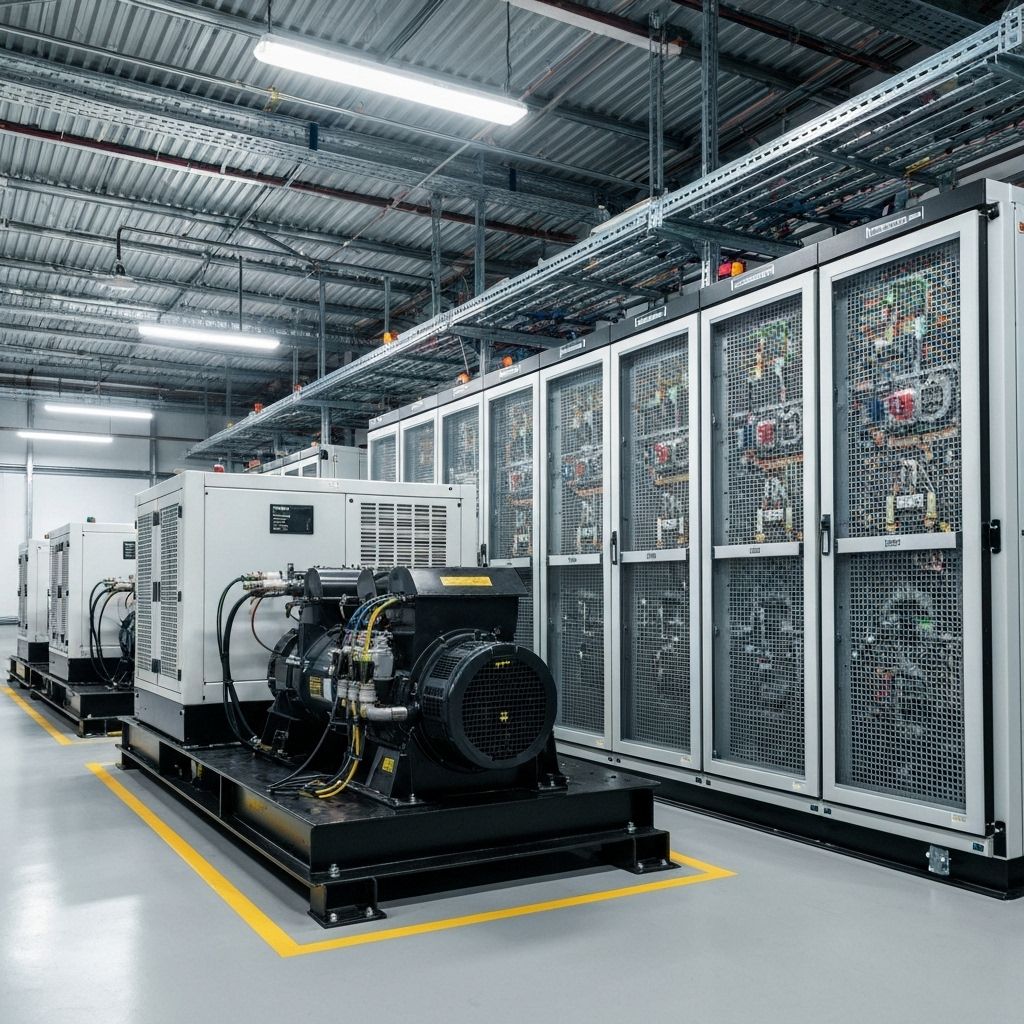
Data Center Power Requirements: Best Practices
Critical considerations for designing reliable power systems for data centers, including redundancy and monitoring.
Introduction
Modern data centers in Pakistan carry national workloads, financial transactions, digital services, and private cloud platforms. Power quality and availability define service reliability, operating cost, and customer trust. A well designed power system reduces risk, improves efficiency, and supports growth.
This guide explains capacity planning, redundancy levels, distribution design, monitoring, and testing. It draws on field lessons from facilities in major cities, and from edge sites with harsh conditions. For solution overviews, see Data Centers and Telecom.
1. Capacity Planning: Getting the Baseline Right
Sizing starts with accurate load data, realistic growth, and an honest view of uptime targets. Data that is optimistic or incomplete will force expensive changes later.
- Inventory all loads, IT racks, cooling, lighting, fire systems, security, and auxiliaries.
- Separate critical, essential, and nonessential loads. Map them to distribution tiers.
- Measure actual demand where possible, use metering or temporary loggers for at least one business cycle.
- Apply diversity and growth, typical planning growth is 20 to 30 percent for two years.
- Convert kW to kVA using power factor. Many facilities run near 0.9, conservative planning uses 0.8.
Working Formula:
Required generator kVA equals Total critical kW divided by Power factor, then add growth reserve.
Example: 800 kW at 0.8 PF becomes 1000 kVA, with 25 percent reserve the selection becomes 1250 kVA, usually deployed as synchronized sets.
For terminology and conversions, visit the Glossary. For engine and alternator envelopes, see Technical Specifications.
2. Redundancy: Choosing the Right Pattern
Redundancy is a policy choice. It balances capital cost, operating cost, and the business impact of downtime. The patterns below are common in regional facilities.
| PATTERN | DESCRIPTION | TYPICAL USE | NOTES |
|---|---|---|---|
| N | Only what is needed to carry the full load | Labs, staging, low criticality | Lowest cost, no tolerance for failure |
| N plus 1 | One additional unit as spare capacity | Most commercial data halls | Good balance of cost and resilience |
| N plus N | Two independent systems, each can carry full load | High criticality, financial and public sector | Higher cost, strong fault tolerance |
| 2N plus 1 | Dual full systems plus a spare unit | Selective national workloads | Rare, used when downtime cost is extreme |
PowerVision typically recommends synchronized generators with automatic load sharing for N plus 1, along with independent fuel and control paths to prevent common mode failure. See Backup Power Solutions and Continuous Power.
3. Power Path and Distribution: From Source to Rack
Design begins at the source, generators, utility incomers, and automatic transfer switches. It continues through switchboards, breakers, and distribution panels, then feeds UPS systems and rack level power strips.
In Pakistan, ambient heat and dust influence ratings, ventilation, and cleaning intervals. Equipment rooms need clear airflow, cable management, and safe working clearances.
Where budgets allow, dual power paths reduce human error risk and improve maintenance windows without shutdowns.
- Place automatic transfer switches upstream of UPS inputs, test weekly
- Use selective coordination, downstream breakers should trip before upstream devices
- Keep neutral and earth references consistent across boards
- Label every feeder and record settings in a change log
- Plan physical separation between A path and B path routes
4. Fuel, Cooling, and Acoustics
Generators are mechanical systems. Fuel stability, heat removal, and sound control affect uptime, compliance, and neighborhood relations.
- Fuel: use clean diesel, water separation, and polishing. Plan for storage autonomy and safe refill points.
- Cooling: size radiators for high ambient conditions, keep airflow paths clear, monitor temperature trends.
- Acoustics: use silent canopies, maintain baffles and seals, verify site limits near residential boundaries.
For maintenance intervals and fluids, review Technical Guides.
5. Monitoring and Control: See It, Then Improve It
Deep visibility shortens incidents and improves fuel performance. Modern controllers and sensors create a useful dataset for operations and finance teams.
Record These Signals:
- Generator state, voltage, frequency, load, fuel, and alarms
- ATS position, transfer time, failure counts
- UPS events, input quality, battery health, output THD
Remote or edge sites benefit from hybrid operation, solar plus diesel with battery support, which reduces fuel use and generator run hours. See Hybrid Systems.
6. Testing, Commissioning, and Periodic Drills
Power systems earn trust through repeatable tests. Commission once, then drill often. Document everything and keep evidence for audits and insurance.
- Cold start test, observe start time and stabilization
- Step load test, record voltage dip and recovery time
- Full load run, minimum thirty minutes at planned load
- ATS functional test, simulate utility failure and restore
- Black start drill, run without utility present
- UPS runtime test, verify alarms and transfer behavior
- Fuel quality check, sample and record water content
7. Cost and Operations: Design for Ownership
Total cost of ownership includes capital, fuel, maintenance, and downtime risk. A synchronized set of medium units can be more efficient than one very large unit because it matches partial loads better.
For budgeting and calculators, review Backup Power, then align maintenance with service level targets.
8. Recommended Baseline: Mid-Size Data Hall
| POWER RANGE | Two to four synchronized generators, 500 to 1000 kVA each |
|---|---|
| REDUNDANCY | N plus 1 at generator layer, dual ATS, dual UPS inputs |
| CONTROLS | Deep Sea synchronizing controllers with remote telemetry |
| FUEL AUTONOMY | Minimum 8 hours on site, safe refill path |
| COMPLIANCE | Euro 5 acoustic canopies, local noise limits verified at boundary |
For engine families and alternator options, see Technical Specifications and the broader Technical Guides.
"Reliable data centers come from simple designs, clear separation of paths, and tests that never stop."
— PowerVision Technical Division
Design the power system to fit the business, then protect it with redundancy and clear operating procedures. Measure everything and practice failover until it is routine. Where operating costs matter, consider solar and storage to reduce diesel runtime, see Hybrid Systems.
About PowerVision
PowerVision is Pakistan's trusted provider of diesel and hybrid generator systems, offering reliable energy from 10 kVA to 2000 kVA. All systems are powered by Lister Petter G-Drive engines, designed for the country's diverse climates and operational challenges. PowerVision's MES-approved, Euro 5-compliant systems are backed by a nationwide service network and AMC support.
Keywords: data center power Pakistan, generator redundancy, N plus 1, N plus N, automatic transfer switch, UPS input, load bank testing, synchronized generators, Deep Sea controller, Lister Petter G Drive, technical guides Pakistan, hybrid power for data centers.